
Arts
Experiences in the arts – dance, drama, media arts, music, and the visual arts – play a valuable role in the education of all students. Through participation in the arts, students can develop their creativity, learn about their own identity, and develop self-awareness, self-confidence, and a sense of well-being. Since artistic activities involve intense engagement, students experience a sense of wonder and joy when learning through the arts, which can motivate them to participate more fully in cultural life and in other educational opportunities.
Teaching Staff
- Mrs. T. Sauve (Dramatic Arts)
- Mr. C. Esposito (Dramatic Arts)
- Mr. S. Wong (Music)
- Mrs. J. Chliszczyk (Art)
Courses
Grade 9
- AVI1O1- Visual Art
- ADA1O1- Drama
- AMU1O1- Music
Grade 10
- AVI2O1- Visual Art
- ADA2O1- Drama
- AMU2O1- Music
- AMG2O1- Guitar
Grade 11
- AVI3M1- Visual Art (must have taken Grade 9 and/or 10 art)
- AWA3O1- Arts & Crafts
- ADA3M1- Drama (must have taken Grade 9 and/or 10 drama)
- AMU3M1- Music (must have taken Grade 9 and/or 10 music)
- AMU3O1- Music
Grade 12
- AVI4M1- Visual Art (must have taken Grade 11 art)
- AWM4M1- Painting and Drawing for Portfolio Building (must have taken Grade 11 art)
- ADA4M1- Drama (must have taken Grade 11 drama)
- AMU4M1- Music (must have taken Grade 11 music)
Art and Design Specialist High Skills Major (SHSM)
Contact Mrs. J. Chliszczyk – Office Workroom 176- email: ChliszczykJ@hcdsb.org
Business Studies & Economics
The Business Department at Loyola offers a wide variety of business courses that challenge and excite students. Courses include topics on Entrepreneurship, Marketing, the Impact of Information Technology, International Business, Management Fundamentals, Accounting, and Economics.
Classes provide a variety of hands-on practical projects, collaborative presentations, guest speakers, field trips, theoretical knowledge, and other technological media to instill the business concepts. Coupled with relevant learning resources and passionate teachers, students find out where Business plays a part in their future!
Teaching Staff
- Ms. D. Balaz
- Mr. M. Colalillo
- Mr. E. Ioanidis
- Mr. J. Kwon
- Mrs. S. MacMillan
- Mr. R. Sebben
Courses
GRADE 9
- BEM 1O – Building the Entrepreneurial Mindset
GRADE 10
- BEP 2O – Leading & Launching a Business
GRADE 11
- BAF 3M – Accounting Fundamentals
- CIE 3M – Economics
- BMI 3C – Marketing
- BDI 3C – Entrepreneurship
- BTA 3O – ICT Digital Environment
GRADE 12
- BAT 4M – Accounting Principles
- CIA 4U – University Economics
- IDC 4UB – Personal Finance
- BBB 4M – International Business
- BOH 4M – Business Leadership/Management
Business Certificate

Can be earned by Grade 12 students who have successfully completed 5 or more Business Studies (including Economics) courses. Graduates can include this on their resume applications to post-secondary schools.
Business Specialist High Skills Major (SHSM)
Contact Mrs. S. MacMillan – Office Workroom 222 – MacMillanS@hcdsb.org
- Business SHSM Information:
- https://hcdsb.elearningontario.ca/d2l/le/lessons/16233531/lessons/177404020
- https://secondary.hcdsb.org/loyola/students/shsm/
Canadian and World Studies
MRS. L. CHEAL, DEPARTMENT HEAD
- Mr. Angaran
- Mr. A. DiNardo
- Mr. D. Faiazza
- Ms. A. Fanelli
- Ms. E. Kania
- Ms. B. Lanois
- Ms. J. Mousseau
- Mr. K. Rachner
The Canadian and World Studies program encompasses five subjects: geography, history, law, politics and civics. In studying these subjects, students learn how people interact with and within their social and physical environments today, and how they did so in the past.
Course Subjects:
Grade 9
- CGC 1D/1P- Canadian Geography (compulsory)
Grade 10
- CHC 2D/2P- Canadian History (compulsory)
- CHV 2O- Civics (compulsory)
Grade 11
- CGF 3M – Physical Geography: Patterns, Processes and Interactions
- CGG 3O – Travel and Tourism: A Regional Geographic Perspective
- CHA 3U- American History
- CLU 3M- Understanding Canadian Law
Grade 12
- CGW 4U- Canadian and World Issues
- CGU 4U- World Geography: Human Patterns and Interactions
- CHY 4U- World History: The West and the World
- CLN 4U – Canadian and International Law
- CPW 4U- Canadian and World Politics
The CWS Department provides opportunities to experience the real world situations as a compliment to classroom instruction.
Opportunities outside the classroom have included the following:
- Mock Trial Competition
- SOMA Model United Nations
- Cultural and Urban Walking Tours of Downtown Toronto
- Welland Canal and Adam Beck Hydro Station Tours in Niagara Falls
- Canadian Warplane Heritage Museum
- Ontario Court of Justice and the Ontario Superior Court
- McMaster University GIS Day
- Guest speakers have included police officers, judges, corrections workers, politicians
- War Veterans and Holocaust presenters
Cooperative Education
Today it’s all about skills…Workplace Skills.
The new differentiator. Employers seek these skills among prospects. Universities and Colleges have incorporated experiential learning through Cooperative Education and Internship Programs across many of their faculty programs. It has become increasingly important for students in high school to look to Cooperative Education to be fully prepared for post-secondary studies and eventual integration into the workforce.
The shift toward experiential learning is not so much in regard to what you learn, but rather how the learning occurs. The ability to learn from everything and everyone around you in any environment and to adapt to solve critical problems. This is exactly what post-secondary institutions look for among student applicants and what employers demand from employee prospects.
The development of these workplace skills is the focus of the Loyola Co-Op Program. The key leadership skills that are critical to building problem solving in a dynamic workplace setting:
- Initiative
- Communication – written / oral / online media
- Interpersonal skills
- Intrapersonal skills / Self-awareness
- Autonomy / Independence
- Adaptability
- Reliability / Dependability
All of these skills exhibited in the workplace form the foundation for the development of a high level of leadership capacity above and beyond the academic skills developed in the traditional classroom. In today’s setting of limiting the spread of viral contagion, experiential learning can take various forms:
- Physically working on-site at an employer workplace following all safety and health protocols
- Virtually performing work for the employer remotely at a site that differs from the employer’s physical workplace
- Employer mentorship which occurs at regular intervals between employer and student remotely or with both employer and student at the employer workplace
The value of experiential learning regarding the workplace is immense in any of the above cooperative learning modes and will lend a strategic enhancement to traditional academic learning.
Welcome to the Loyola Co-Op Program.
Welcome to a key step in developing your leadership profile today!
Contact Mr. R. Sebben sebbenr@hcdsb.org, Mr. J. Mahler mahlerj@hcdsb.org or Ms. D. Orlando orlandod@hcdsb.org for more info.
English
The English Department strives to provide students with literacy skills to communicate effectively, which is not only needed for success in school and their daily lives, but is critical to responsible and productive citizenship. Students are provided with knowledge of literacy strategies and opportunities to develop skills in the areas of listening and speaking, reading, writing, viewing and representing through a wide variety of texts, activities and tasks. In grades 11 & 12, students may select courses at the Workplace, College or University levels, as well as the elective courses: Writer’s Craft and Studies in Literature. Texts are selected to engage students as well as challenge their views of themselves and their world, to make meaningful connections between themselves, what they encounter in texts, and the world around them and to think critically.
English as a Second Language
- The ESL teachers strive to provide students with the knowledge and skills they need to be successful in both their social and academic lives, to become responsible and productive citizens. Students are provided with opportunities to develop the skills necessary to communicate in a variety of social settings. To integrate confidently into mainstream courses, achieve academically and take charge of their learning. Students are offered courses at five levels, depending on their language proficiency as well as support through monitoring by the ESL teachers.
Teaching Staff
- Ms. N. Jones (Department Head)
- Ms. M. Castronovo
- Ms. A. de Souza
- Mr. C. Esposito
- Ms. A. Fanelli
- Ms. J. Infanti
- Mr. E. Ioanidis
- Ms. M. Malandruccolo
- Ms. M. Mascarenhas (MLL)
- Mr. J. Mojica (MLL)
- Ms. T. Osorio Gomez (MLL)
- Mr. G. Rivard
- Ms. A. Santarossa
Courses Offered
- ENG1D1, Grade 9 English
- ENG2D1, Grade 10 Academic English
- ENG2P1, Grade 9 Applied English
- ENG3U1, Grade 11 University English
- ENG3C, Grade 11 College English
- NBE3U1, Grade 11 Native Language Studies University English (ENG3U1 equivalent)
- ENG4U1, Grade 11 University English
- ENG4C Grade 12 College English
- EWC4U1, Grade 12 Writer’s Craft
- ESL A/B/C/D/E
- OLC4O1, Ontario Literacy Course
French / Modern Languages
The Modern Language teachers strive to provide students with the skills they need to communicate in Canada’s second language, focusing on developing oral communication, reading and writing skills. Loyola also proudly offers the French Immersion program, with courses in grades 9 to 12. In the French Immersion program, students accumulate ten credits in French: four are for FSL courses; six are for other subjects in which French is the language of instruction.
Teachers strive to select texts, activities and tasks that are relevant to the students’ lives and appropriate for their communication development. Students may select French as Second Language (FSL) courses at the Applied or Academic level, or the Extended French program (FEF) which also includes courses in Geography, History, and World Religions in French. To further enhance the students’ knowledge of international languages, courses in Italian are also offered in grades 10 & 11.
STUDENTS ENROLLED IN THE EXTENDED FRENCH PROGRAMME MUST COMPLETE SIX EXTENDED FRENCH COURSES (FEF1D1, CGC1DF, FEF2D1, CHC2DF, FEF3U1, HRT3MF) IN ORDER TO TAKE FEF4U1 IN GRADE 12. STUDENTS WHO COMPLETE THE EXTENDED FRENCH PROGRAMME AT THE END OF GRADE 12 WILL RECEIVE THE EXTENDED FRENCH CERTIFICATE AT GRADUATION.
- Ms. Coutu
- Ms. E. Estrela
- Mr. D. Faiazza
- Ms. Kania
Courses Offered
- Grade 9 Core French: FSF1D1 (French Language/Culture)
- Grade 9 Extended French: FEF1D1 (Extended Academic French Language/Culture), CGC1DF (Géographie du Canada)
- Grade 9 French Immersion (FIF1D)
- Grade 10 Core French: FSF2D1 (Academic French Language/Culture)
- Grade 10 Extended French: FEF2D1 (Extended Academic French Language/Culture), CHC2DF (Histoire du Canada)
- Grade 10 Academic French Immersion (FIF2D)
- Grade 10 University Preparation French Immersion (FIF3U)
- Grade 11 Core French: FSF3U1 (University French Language/Culture)
- Grade 11 Extended French: FEF3U1 (Extended University French Language/Culture), HRT3MF (Les Grandes Religions)
- Grade 12 Core French: FSF4U1 (University French Language/Culture)
- Grade 12 Extended French: FEF4U1 (Extended University French Language/Culture)
- Grade 12 University Preparation French Immersion (FIF4U)
Guidance
Guidance Counsellors
| Counsellor | Contact Information | Alpha |
| Mrs. Luis | luisn@hcdsb.org | A – E |
| Mrs. Orlando | orlandod@hcdsb.org | F – I |
| Mrs. Sotiropoulos | sotiropoulosk@hcdsb.org | J – Pe |
| Mrs. Rego | belbeck-regom@hcdsb.org | Ph – Z |
Students are encouraged to visit our Student Services D2L page to find important information to help support pathway planning. Students can also book a time to meet with a counsellor through the D2L page.
Health and Physical Education
Promoting the healthy development of all students and helping all students to reach their full potential.
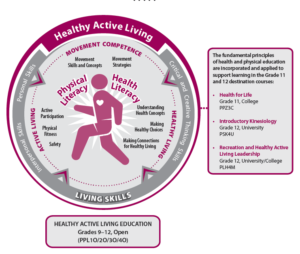
The health and physical education curriculum is based on the vision that the knowledge and skills students acquire in the program will benefit them throughout their lives and enable them to thrive in an ever-changing world by helping them develop physical and health literacy as well as the comprehension, capacity , and commitment they will need to lead healthy, active lives.
Participating in a wide range of physical activities helps students develop knowledge and skills related to movement competence and personal fitness that provide a foundation for active living. Students will learn life skills in a creative, and fun environment, they will interact positively with others, and develop their ability to think critically and creatively while developing their physical literacy.
Course Options
Healthy Active Living Education (Traditional) (PPL) Grade 9-12
Large Group Activities (PAL)
- Basketball Focus Grade 10
- Soccer Focus Grade 9,10,11
Healthy Living Personal Fitness Activities (PAF)
- Weight Training Grade 11/12
Introductory to Kinesiology (PSK 4U) Grade 12
Sports Leadership (PLF 4M) Grade 12
Outdoor Education PAF 4O) Grade 12
LOYOLA HPE DEPARTMENT
- Mr. Costa
- Ms. Humby
- Ms. Orlando – Department Head
- Mr. O’Hara
- Mr. Pauletto
- Ms. Woolvett
Library
Staff
- Ms. M. Bryan, Librarian
- Ms. M. Savitzky, Library Clerk
Resources
Mathematics
MR. R. CENEDESE, DEPARTMENT HEAD
Teaching Staff
- Mrs. A. Alfano (Computers & Math)
- Mrs. R. Commisso
- Mr. J. Mahler
- Mr. M. Matta
- Mrs. D. Mraz
- Mrs. S. Papuga
- Mr. R. Pericak
- Mr. M. Puric
- Ms. K. Rice
- Mr. V. Riviglia
- Mrs. J. Staskovich
- Mr. S. Wong
Courses Offered
- Calculus and Vectors – MCV 4U1
- Advanced Function – MHF 4U1
- Data Management – MDM 4U1
- Mathematics for Work and Everyday Life MEL 4E1
- Functions (University) – MCR 3U1
- Functions and Applications (University/College) – MCF 3M1
- Foundations for College – MBF 3C1
- Mathematics for Work and Everyday Life MEL 3E1
- Principles of Mathematics – MPM 2D1
- Foundations of Mathematics – MFM 2P1
- Mathematics Locally Developed – MAT 2L1
- Principles of Mathematics – MPM 1D1
- Foundations of Mathematics – MFM 1P1
- Mathematics Locally Developed – MAT 1L1
Grade 9 Mathematics EQAO information and extra practice: website
Partnering with your child in mathematics resource: here
University of Waterloo Mathematics Contest
- To register please see your Math Teacher
- Practice Contests: here
Religion
MR. D. D’SOUZA, DEPARTMENT HEAD
Teaching Staff
- Ms. V. Coutu
- Ms. A. de Souza
- Ms. E. Estrela
- Mr. M. Flanagan
- Ms. M. Gallo
- Mr. E. Ioanidis
- Ms. E. Kania
- Ms. B. Lanois
- Ms. Lyons
- Ms. M. Mascarenhas
- Ms. M. Matta
- Ms. B. Memmolo
- Ms. T. Osorio
- Ms. C. Rodrigues
- Ms. T. Sauve
- Mr. F. Tello Quiroga
Courses Offered
- Religious Education – HRE
- World Religions: Beliefs & Daily Life- HRF
- World Religions – HRT
“Preach the Gospel at all times; when necessary, use words”
St. Francis of Assisi
Loyola is a faith based learning environment. The transforming message of truth and hope which is shared with humanity through the Gospels permeates throughout the school and represents the strength and vitality of the Loyola community and culture.
The goal of all courses within the Religion, Humanities and Social Science Department is to help students recognize that life is at its core is a relationship with God. Students are encouraged to develop sacramental awareness and to recognize God at work both in their own lives and in the life of our world. In light of the saving message of the Good News, students explore their responsibility as members of the Church. As servant leaders, students are encouraged to work for positive change in a world that requires their critical participation, building the Kingdom of God through their thoughts, words and actions. Students are also encouraged to ask important questions to help them develop a deeper understanding and appreciation of the Church and its teachings.
A variety of activities embedded both in and outside of the classroom and organized, coordinated and/or supported by members of the Religion Department help to reinforce our mission as a faith based learning environment. Students are encouraged to join a number of clubs that promote human dignity, equity and respect. These include the Social Justice Club and the Pro-Life Club. In conjunction with the Chaplaincy Office, both Grade 9 and 10 students are given an opportunity to go on retreat. In the Grade 11 World Religions program, students are offered an exciting opportunity to visit different places of worship from the many faith denominations represented within the Halton community. The school also offers an opportunity for students to embark on a humanitarian mission to the Dominican Republic as a member of the school’s H.O.P.E. Team (Homes, Opportunity, Prosperity and Education). The program’s goal is to build a house for a needy family. Furthermore, students perform volunteer services in and around the school in order to raise funds to purchase the necessary building supplies for construction.
Science
MR. T. MCCARTHY, DEPARTMENT HEAD
Teaching Staff
- Ms. D. Alexe
- Mr. R. Cenedese
- Mr. J. Chen
- Mr. C. Giannotti
- Ms. S. Humby
- Mrs. V. Kaczmarczyk
- Mr. R. Pericak
- Mr. M. Puric
- Mrs. K. Rice
- Mrs. G. Starcevic
- Mrs. E. Stewart
- Mr. F. Tello Quiroga
- Mrs. L Toews
- Mr. S. Wong
Courses Offered
- SNC1W1 – Gr. 9 Science, De-streamed
- SNC1WP – Gr. 9 Science, De-streamed (STEAM)
- SNC1L1 – Gr. 9 Science, Locally Developed
- SNC2D1 – Gr. 10 Science, Academic
- SNC2DP – Gr. 10 Science, Academic (STEAM)
- SNC2P1 – Gr. 10 Science, Applied
- SNC2L1 – Gr. 10 Science, Locally Developed
- SBI3C1 – Gr. 11 Biology, College
- SBI3U1 – Gr. 11 Biology, University
- SBI4U1 – Gr. 12 Biology, University
- SCH3U1 – Gr. 11 Chemistry, University
- SCH4C1 – Gr. 12 Chemistry, College
- SCH4U1 – Gr. 12 Chemistry, University
- SPH3U1 – Gr. 11 Physics, University
Curriculum Document Information and Links
For Grade 9 Science:
- From “Grade 9 Science Course, 2022”, Ministry of Education
This course enables students to develop their understanding of concepts related to biology, chemistry, physics, and Earth and space science, and to relate science to technology, society, and the environment. Throughout the course, students will develop and refine their STEM skills as they use scientific research, scientific experimentation, and engineering design processes to investigate concepts and apply their knowledge in situations that are relevant to their lives and communities. Students will continue to develop transferable skills as they become scientifically literate global citizens.”
For Grade 10 Science:
- From “The Ontario Curriculum, Grades 9 and 10:Science, 2008 (revised)”, Ministry of Education
“THE GOALS OFTHESCIENCE PROGRAM
Achievement of both excellence and equity underlies the three major goals of the secondary science program. The Ontario Curriculum, Grades 9 and 10: Science, 2008 therefore outlines not only the skills and knowledge that students are expected to develop but also the attitudes that they will need to develop in order to use their knowledge and skills responsibly. The three goals of the science program are as follows:
1. to relate science to technology, society, and the environment
2. to develop the skills, strategies, and habits of mind required for scientific inquiry
3. to understand the basic concepts of science
Every course in the secondary science program focuses on these three goals. The goals are reflected within each strand of every course in the three overall expectations, which in turn are developed in corresponding sets of related specific expectations. The same three goals also underlie assessment of student achievement in science.”
https://www.edu.gov.on.ca/eng/curriculum/secondary/science910_2008.pdf
For Grade 11 and 12 Science:
- From “The Ontario Curriculum, Grades 11 and 12:Science, 2008 (revised)”, Ministry of Education
“THE GOALS OFTHESCIENCE PROGRAM
Achievement of both excellence and equity underlies the three major goals of the secondary science program. The Ontario Curriculum, Grades 11 and 12: Science, 2008 therefore outlines not only the skills and knowledge that students are expected to develop but also the attitudes that they will need to develop in order to use their knowledge and skills responsibly. The three goals of the science program are as follows:
1. to relate science to technology, society, and the environment
2. to develop the skills, strategies, and habits of mind required for scientific inquiry
3. to understand the basic concepts of science
Every course in the secondary science program focuses on these three goals. The goals are reflected within each strand of every course in the three overall expectations, which in turn are developed in corresponding sets of related specific expectations. The same three goals also underlie assessment of student achievement in science.”
https://www.edu.gov.on.ca/eng/curriculum/secondary/2009science11_12.pdf
Brief Course Descriptions (last updated December 2025)
- SNC1W1 or SNC1WP – Grade 9 Science, De-streamed
(This course is also offered in the STEAM program.)
The Grade 9 De-streamed science course enables students to understand fundamental concepts in Biology, Chemistry, Physics, and Earth and Space Science. They will develop skills in the processes of scientific inquiry, STEM skills, and skills that demonstrate the relationships between science, technology, society, and the environment. Students will gain insight about: the periodic table and how atoms are joined to form compounds and mixtures in the Chemistry strand; the fundamentals of electric charge and electric circuits in the Physics strand; ecosystems and biodiversity in the Biology strand; and the makings of our solar system in the Earth and Space Science strand. Some typical strand projects and lab experiments may include: performing research on an element; tracking home electrical energy use, building series and parallel electrical circuits; creating a brochure on an endangered species; and making a scale model of our solar system. Some additional STEM Investigation Skills may include: applying an engineering design process to design, build and test a device; applying coding skills to investigate; and model scientific processes. This course will provide students with a solid foundation for the study of science in Grade 10.
- SNC1L1 – Grade 9 Science, Locally Developed
The Grade 9 Locally developed Science course is intended to give students a sample of different areas of science including chemistry, physics, and biology. The course involves learning the necessary knowledge and skills that apply to everyday life situations. Students will experiment with different chemicals, to understand their properties and how they can be changed. Students will learn how to draw and build a simple circuit, as well as take measurements involving current and voltage. Students will also learn about the organ systems and dissect a frog. Students will also have an opportunity to work with plants and experiment with the conditions necessary for them to grow. This course is intended for students looking to enter the workplace upon completion of high school.
(This course is also offered in the STEAM program.)
The Grade 10 Academic Science course is intended to broaden student knowledge in the key branches of science related to Biology, Chemistry, Physics, and Earth and Space Science. This course provides a great deal of information and necessary background for students to decide which science course(s) they choose to pursue in Grade 11. Students will deepen their understanding of: the periodic table and how it pertains to chemical reactions in chemistry; optics in physics; cells, tissues, and organ systems in biology; and, aspects pertaining to climate and its change over the years in earth and space science. Some typical strand projects and lab experiments may include: experiments involving physical and chemical changes, the creation of an application poster involving chemical reactions, experiments shining light rays onto mirrors and through lenses, writing a research paper on aspects dealing with cells and/or tissues, a dissection of fish and/or a bullfrog, and a writing a report on a current environmental issue affect our planet. The knowledge and skills gained in this course will prepare students for senior level science courses.
- SNC2P1 – Grade 10 Science, Applied
The Grade 10 Applied Science course covers Biology, Chemistry, Physics, and Earth and Space Science. The Biology strand covers different systems in the body, and all the cells, tissues, and organs that make up these individual systems. The Chemistry strand looks at how chemicals react with one another, as well as how these chemicals are used in the workplace and at home. The Physics strand investigates different types of optical devices, and properties of some devices such as mirrors and lenses as well as the properties of light and colour. The Earth and Space Science strand looks at how our climate is affected by natural and human causes, and how these causes impact our local environments. The knowledge and skills gained in this course will prepare students for senior College level science courses.
- SNC2L1 – Grade 10 Science, Locally Developed
The Grade 10 Locally developed Science course is intended to expand students’ understanding of the different areas of science including chemistry, physics, and biology. The course involves learning the necessary knowledge and skills that apply to everyday life situations. Students will experiment with different chemicals, to better understand how they behave and their uses in everyday items such as detergents and toothpaste. Students will also build circuits and learn to draw and make circuits with multiple loads. Students will continue to expand their knowledge about the organ systems and structure of plants. This course is intended for students looking to enter the workplace upon completion of high school.
- SBI3C1 – Grade 11 Biology, College Level
The Grade 11 College Biology course is designed to introduce a vast array of biological concepts in a very informal classroom setting where current events related to the curriculum are discussed on both a personal and global scale. The students will come to appreciate the science around them with hands on activities, lab work and internet research assignments. The strands covered are Cellular Biology, Microbiology, Genetics, Anatomy of Mammals, and, Plants in the Natural Environment. What pandemics have devastated our world throughout history? Did you know there is fungi that can create zombies? How come your sibling looks so different from you? These and many other topics may be discussed in class. Students always look forward to the Rat Dissection lab that allows everyone to acquire hands on experience that may come in handy if you are thinking about pursuing a career in Lab Technology, Nursing, or Nutrition. This course will provide students with a solid foundation for the study of Biology at Community College.
- SBI3U1 – Grade 11 Biology, University Level
The Grade 11 University Biology course is designed to give students an insight into the field of Biology and to appreciate the complexities of living things. It is suitable for both students who wish to continue further with their studies in Biology as well as those who just want to know more about the world around us. The strands covered are Diversity of Living Things, Evolution, Genetic Processes, Animals: Structures and Functions, and Plants: Anatomy,
Growth and Function. What could be more exciting and fascinating than finding out how our body works, how we inherit our traits from our parents and how many amazing, fascinating species of living things inhabit our earth? The students may dissect a mammalian heart as well as a mammal. With the help of preserved and living samples, the students may examine fascinating specimens of insects, crustacea, amphibians and many more diverse organisms both microscopic and macroscopic. This course will provide students with a solid foundation for Grade 12 University Biology.
- SBI4U1 – Grade 12 Biology, University Level
The Grade 12 University Biology course is an excellent preparation course for those students who are considering pursuing their studies in Biology or the Life Sciences at a post-secondary level as well as those students who have taken Grade 11 Biology and wish to explore the Biology Strand in greater depth. The course is designed to offer a broad range of strands such as Biochemistry, Metabolic Processes, Molecular Genetics, Homeostasis, and Population Dynamics. As well as learning the theory behind the subjects, the students learn the everyday applications of their knowledge such as DNA Extraction, testing for nutrients and exploring how enzymes function through lab work. In Homeostasis, students will learn how many hormonal disorders that affect the human population are caused and treated and the fascinating behaviour of the human brain. The study of Biology can lead students to a wide variety of careers from Laboratory Technician, Landscaping and Garden Design, Microbiologist, Marine Scientist to all aspects of the Medical profession. This course will provide students with a solid foundation for the study of Biology at University.
- SCH3U1 – Grade 11 Chemistry, University Level
Grade 11 University Chemistry is intended for those students who enjoyed the chemistry strands of Grade 9 Science and Grade 10 Science and wish to further develop their chemistry skills and knowledge. Many of the concepts learned in this course lay the foundation for further extension in Grade 12 University Chemistry and beyond. Nomenclature (the naming of chemicals) is covered in Matter, Chemical Trends, and Chemical Bonding and is then used throughout the course. Types of reactions are studied in Chemical Reactions. Stoichiometry (the math of chemistry) is covered in great detail in Quantities in Chemical Reactions, Solutions and Solubility, and Gases and Atmospheric Chemistry. Many of the core concepts are extended even further through experimental investigations in a lab environment. Students may have the opportunity to observe various chemical reactions as well as find experimental observations to compare to theoretical values. The knowledge gained in this course is vital for success in the Grade 12 University Chemistry course.
- SCH4C1 – Grade 12 Chemistry, College Level
The Grade 12 College Chemistry course will prepare students for science related college programs and their careers. The strands covered are Matter and Qualitative Analysis, Organic Chemistry, Electrochemistry, Chemical Calculations, and Chemistry in the Environment. To develop an understanding of chemistry, students may: investigate matter using various methods of qualitative analysis; investigate the properties of organic compounds and their impact on the environment; investigate oxidation-reduction reactions of electrochemistry and their applications; analyse processes that use chemical quantities and calculations; and investigate chemical reactions that occur in the environment that affect our air and water quality. Emphasis will be placed on the role of chemistry in daily life. Some investigations that students may perform include analyzing and identifying unknown samples (as in CSI); building a galvanic cell/battery and measure its voltage; determining the predicted and actual amounts of products formed in a chemical reaction; and detecting the presence of inorganic substances and pollutants in samples of water. This course can lead to a variety of careers which include agricultural technologist, biochemical technologist, chemical engineering technologist, crime scene investigator, dental hygienist, electroplating technician, environmental technologist, food inspector, green building or renewable energy technician, paramedic, pharmacy technician, practical nurse, veterinary technician, and water treatment plant operator. This course will provide students with a solid foundation for the study of Chemistry at Community College.
- SCH4U1 – Grade 12 Chemistry, University Level
Grade12 University Chemistry is a challenging course intended for those who have a genuine interest in chemistry and plan on possibly pursuing the sciences in a post-secondary setting. The information learned in the Grade 11 University Chemistry course is extended and related to the strands Organic Chemistry, Structure and Properties of Matter, Energy Changes and Rates of Reaction, Chemical Systems and Equilibrium, and Electrochemistry. In the lab, students may have the opportunity to see first-hand the effects of several factors and their effects on the rate of a chemical reaction. Students may also explore through experimentation the heat transferred in endothermic and exothermic reactions. Potential career paths that could be followed with success in this course may include pharmaceuticals, engineering, the medical field, environment related careers and research. This course will provide students with a solid foundation for the study of Chemistry at University.
- SPH3U1 – Grade 11 Physics, University Level
The Grade 11 University Physics course is intended to give students a deeper look at the physical world around them. It is an excellent introduction to the field of physics and provides the necessary background for the Grade 12 University Physics course. Students are introduced to the uses of electromagnetism in Electricity and Magnetism, applications of waves in Waves and Sound, the description of motion in Kinematics, the cause of motion in Forces, and energy transformation and transfer in Energy and Society. This course relies heavily on inquiry through experimentation. Some typical strand projects that may be encountered are: the simulation and construction of a traffic signal intersection model using an Arduino UnoR3 microcontroller and a TinkerCAD simulation; the production of a stop motion animation to explain motion; and, a RAFTS (Role, Audience, Format, Topic, Strong Verb) paper or presentation of an aspect of nuclear physics. The knowledge and skills gained in this course are vital for success in the Grade 12 University Physics course.
- SPH4C1 – Grade 12 Physics, College Level
The Grade 12 College Physics course is intended to give students the necessary skills and knowledge to pursue sciences or engineering at the college level. Students investigate the uses of technology in the study of motion in Motion and Its Applications, learn how forces affect our daily lives in Mechanical Systems, probe the impact of electromagnetism in Electricity and Magnetism, look at energy transformation and transfer in Energy Transformations, and investigate the properties and uses of fluids in Hydraulic and Pneumatic Systems. Some typical strand research papers or presentations topics may include: the evolution of an electrical device; the impact of an electromagnetic device; the impact of a transportation technology; the use of a common mechanical system; energy transformations in use; and the use of robotic systems. Some typical strand projects may include: the simulation and construction of a traffic signal intersection model using an Arduino UnoR3 microcontroller and a TinkerCAD simulation; the production of a stop motion animation to explain motion; the design and construction of a compound machine; the design and construction of an energy transformation device; the design and construction of a hydraulic system. The topics covered by this course may require the use of simulations for exploration. Careers possible include engineering technology, science technology, and the trades. This course will provide students with a solid foundation for the study of Physics at Community College.
- SPH4U1 – Grade 12 Physics, University Level
The Grade 12 University Physics course is intended to give students the necessary skills and knowledge to pursue sciences or engineering at the university level. The investigations of the physical phenomena studied draw more heavily on mathematics. Students deepen their understanding of the causes of motion in Dynamics, expand their understanding of energy in Energy and Momentum, explore applications of gravitational, electric and magnetic forces and fields in Gravitational, Electric and Magnetic Fields, explore aspects of light as a wave in the Wave Nature of Light, and begin to probe the weirdness of modern physics in Revolutions in Modern Physics: Quantum Mechanics and Special Relativity. The topics covered by this course may require the use of simulations for exploration. Some typical strand projects that may be encountered are: design an experiment using an available web-based computer simulation; a research paper on applications of gravitational, electric and magnetic fields; and, an oral presentation of a current topic (less than 10 years old) in physics. Careers possible include engineering, science and medicine. Students considering a career in medicine should consider taking this course as Physics is assessed on the MCAT. This course will provide students with a solid foundation for the study of Physics at university.
Social Sciences and Humanities
MR. D. D’SOUZA, DEPARTMENT HEAD
Teaching Staff:
- Ms. V. Coutu
- Mr. D. Faiazza
- Mr. M. Flanagan
- Ms. L. Kellner
- Ms. M. Malandruccolo
- Ms. M. Matta
- Ms. B. Memmolo
- Mr. G. Rivard
Courses Offered:
- Nutrition and Health – HFA
- Human Growth and Development – HHG
- Raising Healthy Children – HPC
- Challenge and Change in Society – HSB
- Equity and Social Justice – HSE
- Introduction to Anthropology, Psychology – HSP
- Philosophy – HZT
“Preach the Gospel at all times; when necessary, use words”
St. Francis of Assisi
Loyola is a faith based learning environment. The transforming message of truth and hope which is shared with humanity through the Gospels permeates throughout the school and represents the strength and vitality of the Loyola community and culture.
The goal of all courses within the Religion, Humanities and Social Science Department is to help students recognize that life is at its core is a relationship with God. Students are encouraged to develop sacramental awareness and to recognize God at work both in their own lives and in the life of our world. In light of the saving message of the Good News, students explore their responsibility as members of the Church. As servant leaders, students are encouraged to work for positive change in a world that requires their critical participation, building the Kingdom of God through their thoughts, words and actions. Students are also encouraged to ask important question to help them develop a deeper understanding and appreciation of the Church and its teachings.
A variety of activities embedded both in and outside of the classroom and organized, coordinated and/or supported by members of the Religion Department help to reinforce our mission as a faith based learning environment. Students are encouraged to join a number of clubs that promote human dignity, equity and respect. These include the Social Justice Club and the Pro-Life Club. In conjunction with the Chaplaincy Office, both Grade 9 and 10 students are given an opportunity to go on retreat. In the Grade 11 World Religions program, students are offered an exciting opportunity to visit different places of worship from the many faith denominations represented within the Halton community. Furthermore, students perform volunteer services in and around the school in order to raise funds to purchase the necessary building supplies for construction.
Special Education
Information:
Gifted and Enrichment Opportunities
Simona Horvat – Department Head of Special Education/Gifted Contact
horvatsi@hcdsb.org or call at (905) 847-0595 ext. 1026
In addition to a student’s involvement in the life of the school, participating in enrichment opportunities is a way to support our Gifted and high-achieving students academically. These opportunities allow our students to gather experiences to include in their resumes and portfolios for applications to post-secondary and future jobs.
There are curricular and extra-curricular enrichment opportunities available to students over the course of the school year at St. Ignatius of Loyola Catholic Secondary School. Some of the many opportunities students regularly access include:
- Math Contests – Cayley, Euclid, Pascal
- Duke of Edinburgh Award
- SOMA (Model UN)
- Schulich Award nominees for STEM (Science, Technology, Engineering, Math) – Loyola was the only Oakville School nominated
- Loran Scholarship
- Mentors – Student Leaders
- SHSM (Specialist High Skills Major) – Health and Wellness
- Discovery Days – Western and McMaster Health Science, Waterloo Engineering
- Mock Trial
- School Reach Team
- Debate Team
- Best Buddies
- Social Justice League
- Ontario Junior Citizen Awards
Events are often announced during morning exercises, and are posted on the T.V.’s located at the front of the school, in the cafeteria and on our school website. Students are welcome to contact Mrs. Horvat, Department Head of Special Education, or their guidance counselor for more information as well.
There are even more out-of-class enrichment opportunities for secondary school students. These include project-based learning, independent studies, mentorships, and career exploration. Students are encouraged to review these opportunities to see where their particular interests match. Many of these opportunities are specifically designed for gifted and/or high achieving students, and they offer students a means of enriching levels of learning, leadership potential, and personal confidence. Anyone can apply to participate in these activities. Please note that all activities listed are voluntary, and are predominantly student-initiated.
These enrichment opportunities are listed below. To get more, simply click onto the blue underlined name.
McMaster University:
CLAY (Creating Leadership Amongst Youth) – This is a 3 day/2 night leadership conference which allows students to develop and share their knowledge of leadership. Online registration is now available.
L.E.A.P. (Learning Enrichment Advancement Program) – Leap is a summer enrichment program offered at McMaster University. Students can choose to stay in one of McMaster’s student residences for the duration of their 2 or 4 week program. LEAP offers students a chance to explore new ideas in one of 4 areas: Introduction to Engineering, Engineering Design, Engineering Technology, and Bioengineering. Programs are available to students from grades 9 to 12 in selected areas.
SYNERGY (DeGroote School of Business) – Synergy is a week long business camp designed to explore business in a creative and challenging way. The camp is designed for high school students, programs run from June – August.
University of Waterloo:
Waterloo Unlimited – High School Enrichment at the University of Waterloo: Waterloo Unlimited is a unique enrichment opportunity for high school students in grades 10 through 12. Offered during the school year, Unlimited brings together curious, motivated, well-rounded teens from across the country.
CATALYST – The program empowers high school youth to be the agents of change in our community and our world by creating opportunities for them to increase awareness, confidence and leadership abilities in engineering, science and technology. Programs include a Grade 11 Girls Conference in April – applications are due in December/January.
Engineering Science Quest Program (ESQ) – A year round program which offers Classroom Workshops, Summer Day Camp, and Weekend Workshops. Helps develop an appreciation for science and engineering in elementary school children, and to encourage them to pursue these areas in high school and possibly beyond.
Western University:
W.I.S.E. program – Students can take a university course while still in high school. WISE will allow you to take one university course, tuition free, concurrently with your high school studies. Student can try out a first-year course in Anthropology, Business Administration, Dimensions of Leadership, English, Family Studies, Foods & Nutrition, French, Philosophy, Political Science, Psychology, Religious Studies, Sociology or Women’s Studies at Brescia. If students pass the university course, they can apply this course to their university career at Brescia.
Western Engineering Summer Academy – For grades 9 – 12. The Western Engineering Summer Academy is designed specifically for enriched Grades 9 to 12 high school students looking for a challenge this summer. The Academy offers students the opportunity to explore these areas of engineering with labs, lectures and hands on projects. The courses are taught by our very own professors and graduate students. Registration occurs in January. The four courses that will be offered are: Mechanical Engineering, Civil Engineering, Mechatronics Engineering and Biomedical Engineering.
University of Toronto:
D.E.E.P. – University of Toronto’s DaVinci Engineering Enrichment Program is is part of the University of Toronto’s Engineering Outreach Programs . DEEP is for gifted and highly motivated high school students who wish to advance their study in a variety of areas of engineering. DEEP is a week long program (there is a choice of weeks) and it is held at the St. George campus (downtown Toronto). There is also a residence option available.
Youth Summer Programs at University of Toronto –These programs are offered during July and August for high school students who are interested in a career in either medical sciences or the legal field. The Faculty of Medicine and the Faculty of Law will provide academic programs for students with their faculty at the university facilities. The program runs a variety of modules from July to August.
Queen’s University:
ESU – Enrichment Studies Unit – Queen’s University offers a week long program Enrichment Mini Courses (EMC) to gifted and highly motivated students. It can include staying in Queen’s University residence and students can select course programs from business, creative arts, cultural studies, law, medicine, natural and physical sciences, physical education, psychology and sociology, and pure and applied science. This program runs in May, but registration is due in February.
Other Programs:
Heritage Canada’s Encounters with Canada – A unique opportunity for Canadian teens to meet other young people from across the country. Spend an adventure-filled week in your nation’s capital. Opportunities to check out future career options, discover your country, share your hopes and dreams. For 35 years, EWC has delivered a rich and varied, bilingual program. To date, more than 108,000 youth have lived the EWC experience.
SHAD – Shad is a 4 week summer enrichment program for students who are high academic achievers, leaders, and innovators. SHAD programs are focused on STEAM (science, technology, engineering, arts & math). Students may apply for one of several Canadian university sites for their studies. Students in grades 10, 11, or 12 are invited to apply. The application deadline is late November. Why SHAD? – find out here.
The International Summer School for Young Physicists –The Perimeter Institute for Theoretical Physics, Waterloo, Ontario. This program is for students who have completed their senior level high school courses specifically in mathematics and physics and plan to study physics at university. Students must be 17 – 18 years of age. This program is free to those selected to attend. The program runs July but applications are due in December.
Boyd Archaeological Field School at TRCA – Earn a credit (IDC4U1) while doing real archaeological field work. This 17 day course will run during July. This program is open to students who have completed their grade 10 year. Applications are due May 1.
re:action 4 inclusion – This is a 3 day leadership conference in March at YMCA Geneva Park Conference Centre, Orillia. The focus of this conference is to promote inclusion and building a sense of community to ensure that those who have an intellectual disability don’t get left behind. To register or for details got to www.communitylivingontario.ca or contact Linda White at 1-800-278-8025 ext 239
House of Commons Page Program – Students who plan to attend university in the National Capital Region may apply to this program. Pages are a key element in the communications network on Parliament Hill and students who participate will have a unique opportunity to meet and work with our federal politicians. Students in this program will work a minimum of 15 hours per week (coordinated with their academic schedule). Students applying for this program must be Canadian citizens, beginning a university program, have an overall academic average of at least 80%, and have a superior knowledge of both official languages. The application is available in October and is due by early December for positions in the following year.
Explore Without Limits – French Language Bursary Program: Discover another region of Canada and use this opportunity to improve your knowledge of French. Explore offers you five weeks full of opportunities to make discoveries, meet new people, and exchange ideas in a stimulating setting for learning your second language. Participants in Explore receive a $2,000 bursary covering tuition fees for the course, instructional materials, meals, and accommodation. Choose either a spring session (May – June ) or a summer session (June – August).
Katimavik – The Katimavik program has been re-started in a limited format. The Eco-Internship is currently running for 3 months in Quebec. New opportunities may emerge, please continue to check this website for information.
Boyd Archaeological Field School at TRCA– The 38th season of Boyd Archaeological Field School takes place from August August 7th – 23rd, 2015 at the Claremont Field Centre in Pickering, Ontario, Canada. Students complete a Grade 12 Interdisciplinary Studies Credit (IDC4U) while participating in all aspects of an actual excavation. Students MUST have completed grade 10 by the time the course starts.
Vancouver Film School – Summer Intensives – VSF has one week programs in a variety of areas including Acting, Animation, Art and Design, Film Production, Game Design, Make-up, Sound, and Writing.
Cornell University Summer College Program –Cornell University is an IVY League school offering summer programs for talented high school students. Students can select either a 3 week or a 6 week program. Application deadlines begin in March (depending on the program of choice) and applications are extensive, so make sure to start your application early.
Oxford Study Courses for IB and pre-IB Diploma Programme Students University of St. Andrews – Creative Writing and Scottish Studies Summer Program –This is a 4 week residential program offered to students who have completed their grade 10 (or higher) studies. Students will have opportunities to go on excursions and visit important sites, have a full recreation and social program provided, and learn from professors, graduate students and guest speakers.
Yale Young Global Scholars Program – In 2018, the Yale Young Global Scholars Program (YYGS) will offer seven unique interdisciplinary sessions over the course of the summer. Bringing together extraordinary students from around the world, each session is designed to hone students’ abilities to understand and think critically about contemporary global issues. Students will have the opportunity to learn from distinguished Yale faculty members, participate in seminars designed and led by current Yale students, and engage with practitioners who are renowned leaders in their field — all while experiencing the world-class facilities and resources that Yale University has to offer. Admission to the program is very selective. We offer need-based financial aid and encourage students from all countries to apply. The deadline for applications is Feb 6, 2018.
Deep River Science Academy (DRSA) – A six-week summer program for talented high school students. Science and engineering research experience in labs of industrial Research Partners
DiscoverTeenergy.com – Featured topic: “Activities Database” has over 500 listings of events especially for gifted students. Database includes: conferences, leadership training, student travel, international exchanges and learning opportunities, unusual places to visit, something for many interests and hobbies.
- Are you a grade 11 student looking for a challenge? Become a part of the Science Centre for a semester of Grade 12! Earn SCIENCE and MATH credits. Explore new science and technology. Be inspired for life. Spend an enriching semester at the Ontario Science Centre Science School and earn Grade 12 University Preparation science and mathematics credits!
Study Abroad Programs:
Technology
MR. R. PENDER, DEPARTMENT HEAD
Greetings from the Loyola Technological Studies Department
Why should I consider Technology programs?
The future is not written, but why not prepare yourself? Technology courses offer hands on skills in a variety of areas under the guidance of teachers who have invaluable industry experience. Technology courses provide PATHWAYS to many post secondary programs (at both college and university) as well as apprenticeship and workplace and will give you an advantage as you continue on your journey. Safety is always a priority within all our courses.
Technology programs offered at St. Ignatius of Loyola include:
- Communication Technology
- Computer Science
- Computer Programming
- Construction Technology
- Custom Woodworking
- Hairstyling and Aesthetics
- Hospitality and Tourism
- Technological Design
- Transportation Technology
Take some time and stop by any of our classrooms to see all the exciting things that are happening. Ask the teacher and they will be happy to provide information of the individual programs.
Here are the teachers in our department and where you can find them.
- Mr. R. Pender Rm. 165 – DEPARTMENT HEAD
- Mrs. A. Alfano Rm. 285 Computer Science
- Mr. M. Buzzelli Rm. 167 Tech Design + Computer Engineering + Computer Science
- Ms. M. Cabral-Paulo Rm. 181 Cosmetology
- Mr. B. Chambers Rm. 173 Yearbook, Communication Technology + TV, Video Movie Production
- Ms. S. Fanara Rm. 167 Communication Technology + Fashion Design
- Ms. M. McMurrich Rm. 169 – Communication Technology + Media Arts
- Mr. M. O’Neill Rm. 161 Woodworking + Tech Design and Construction
- Mr. R. Pender Rm. 165 Transportation Technology, Transportation & Construction
- Mr. J. White Rm. 179 Food and Nutrition
Technology Fair
- Every February the Technology Department has a Technology Fair in the School atrium. Come down and check it out!
Halton Skills Competition
- In April of each year Loyola Students compete in different disciplines
- Check out https://haltonskills.ca/ for more details.
Computer Programming Competitions
- Students can compete in the following programming competitions. Please see Mrs. Alfano in Rm 285 for details.
- February – University of Waterloo Programming Competition (Junior and Senior Levels)
- March – Board Level Computer Programming Competition